
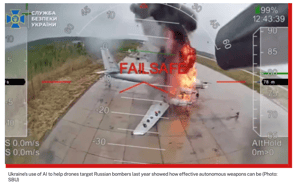
General Sir Richard Barrons comments in The i Paper on how artificial intelligence and autonomous systems are changing modern warfare.
Artificial intelligence and autonomous weapons are no longer distant defence concepts. They are already influencing how wars are fought, how targets are identified, and how military commanders think about speed, scale and risk on the modern battlefield.
In a major article for The i Paper, General Sir Richard Barrons KCB CBE, Co-Chair of Universal Defence and Security Solutions and co-author of the UK Strategic Defence Review, sets out the strategic reality now facing the UK and its allies. The article examines how AI, drones, uncrewed platforms and autonomous systems are reshaping warfare across land, sea, air and space.
Why AI and autonomy matter in modern warfare
Recent conflicts have shown that autonomous and semi-autonomous systems can alter the balance of military power. From drone warfare in Ukraine to AI-assisted targeting and uncrewed platforms, the pace of technological change is accelerating.
General Sir Richard Barrons highlights that lethal autonomous weapon systems are already proliferating. These systems can offer clear military advantages: they can improve survivability, reduce risk to personnel, and place machines in situations where sending humans would be too dangerous.
But the same technologies also raise serious ethical, legal and operational questions.
The challenge: speed, accountability and human control
As AI becomes more embedded in defence decision-making, the central question is not whether the technology will be used, but how it will be controlled.
Autonomous systems may be able to act at machine speed, but warfare still requires human judgement. Barrons is clear that the UK and its allies must confront the moral consequences of deploying weapons that could become, in his words, “unstoppable by the people who fired them.”
That concern becomes even more serious when applied to nuclear decision-making. AI may help leaders assess threats, improve certainty and generate response options under extreme pressure. However, Barrons argues that the final decision must remain with a human being, including the ability to reject AI-generated recommendations.
What this means for UK defence
The UK faces a strategic challenge: how to adopt AI and autonomous systems quickly enough to remain militarily credible, while ensuring that human accountability, legal standards and ethical safeguards remain at the centre of defence policy.
This is not just a technology issue. It is a question of deterrence, resilience, procurement, doctrine and political judgement.
The future of warfare will be shaped by states that can combine technological advantage with disciplined human decision-making. For the UK, that means investing in AI and autonomy while being clear about where human authority must remain non-negotiable.
Read the full article
General Sir Richard Barrons’ comments form part of an important wider analysis by The i Paper on how the UK may fight wars in the age of AI and autonomous weapons.
Read the full article here:
https://inews.co.uk/news/technology/how-uk-fight-wars-age-killer-robots-4356700