UDSS Director Vice Admiral Duncan Potts, CB, warns that the threat to shipping in the Strait of Hormuz cannot be measured only by the destruction of Iran’s conventional naval assets.
The Strait of Hormuz remains one of the most strategically important maritime chokepoints in the world. Around a fifth of global daily oil and liquefied natural gas supply normally passes through the route, making disruption there a direct concern for governments, energy markets, insurers, shipowners and global trade.
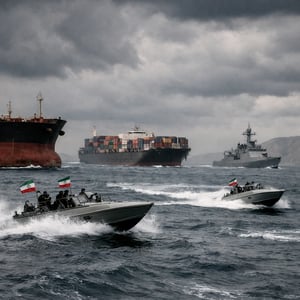
Recent reports of Iranian fast-boat swarms being used to seize container vessels near the strait underline a critical point: even where a conventional naval threat has been degraded, the maritime risk has not necessarily disappeared.
Instead, the threat appears to be shifting.
A layered maritime threat
Iran’s fast-attack craft form part of a wider, layered system of maritime pressure. These small, agile vessels add to an already complex threat picture that includes shore-based missiles, drones, mines, electronic interference and the possibility of vessel seizure.
For commercial shipping, this creates a particularly difficult operating environment. Merchant vessels are not designed or equipped to defend themselves against armed state forces. Even a limited number of fast boats can create uncertainty, delay decision-making and increase the cost and complexity of transiting the region.
This matters because disruption in Hormuz does not need to involve a major naval battle to have strategic consequences. The seizure of a small number of vessels, or even the credible threat of further seizures, can influence insurance premiums, routing decisions, chartering confidence and market sentiment.
Why asymmetric tactics matter
Vice Admiral Duncan Potts, CB, UDSS Director points to the historical lesson of the 1980s “tanker war”, when Iran increasingly relied on asymmetric methods after its conventional naval power was heavily constrained.
As he notes, the destruction of larger naval assets does not remove the threat if the adversary has already adapted.
“When the U.S. Navy and the president say, ‘We’ve destroyed the navy’… you’ve done that before, but you’ve forgotten that your opposition here went asymmetric. And they’ve perfected it.”
That insight is central to understanding the current challenge. Conventional measures of naval strength can be misleading when an adversary’s strategy is built around dispersal, speed, concealment and tactical unpredictability.
Fast boats are not designed to defeat a warship in a direct confrontation. Their value lies in ambiguity, speed of action and their ability to operate among civilian maritime traffic, coastal infrastructure and cluttered littoral environments.
The challenge for shipping and insurers
For the shipping sector, the immediate concern is not whether fast boats can survive against a modern naval task group. It is whether they can generate enough risk to disrupt normal commercial operations.
That risk is already visible in several ways:
- Increased uncertainty for vessels approaching or transiting the Strait of Hormuz
- Higher war risk and insurance considerations
- Greater demand for route planning, intelligence and threat monitoring
- Pressure on governments to provide reassurance and maritime security presence
- Increased operational complexity for shipowners, operators and charterers
The issue is not only physical security. It is also confidence. Once shipowners and insurers begin pricing in the possibility of seizure, delay or escalation, the consequences can spread well beyond the immediate maritime area.
Strategic resilience in contested waters
The renewed focus on fast-boat swarms reinforces a wider lesson for governments and industry: resilience depends on understanding the full threat environment, not only the most visible or conventional elements of it.
For maritime operators, that means looking beyond headline military assessments and considering how state and non-state actors may adapt under pressure. For governments, it means recognising that freedom of navigation requires sustained attention to asymmetric, grey-zone and hybrid methods as well as conventional naval power.
The Strait of Hormuz is not just a shipping lane. It is a strategic pressure point. Events there can affect energy security, supply chains, insurance markets and geopolitical stability.
As Vice Admiral Potts’ comments make clear, the danger lies in assuming that a degraded conventional navy equals a neutralised maritime threat. In reality, Iran’s ability to operate asymmetrically may now be one of the defining risks facing commercial shipping in the Gulf.
UDSS view
The latest developments in the Strait of Hormuz highlight the need for clear-eyed strategic analysis, maritime risk awareness and practical resilience planning. Fast-boat swarms, vessel seizures, missiles, drones, mines and electronic interference should not be viewed in isolation. Together, they form a complex operating picture that requires informed judgement and coordinated response.
For organisations exposed to maritime, energy, logistics or supply chain risk, the message is clear: disruption in Hormuz remains a live strategic concern, and the threat is evolving rather than disappearing.
Original source: https://www.reuters.com/world/asia-pacific/iran-fast-boat-swarms-add-hormuz-threats-shipping-2026-04-23/