

The ultimate test of defence policy is not the ambition of the strategy, the scale of the announcement or the promise of future investment. It is whether the people sent to defend the nation have been properly prepared to do so.
Giving evidence to the House of Commons Defence Committee following the publication of the UK Defence Investment Plan, General Sir Richard Barrons delivered a stark warning about the consequences of delay:
“You are going to be confronting a moral failure because you will be sending today’s armed forces, who are all somebody’s children, into the field in three years’ time, knowing you chose not to prepare them properly.”
This is the central issue now confronting UK defence policy.
Watch:
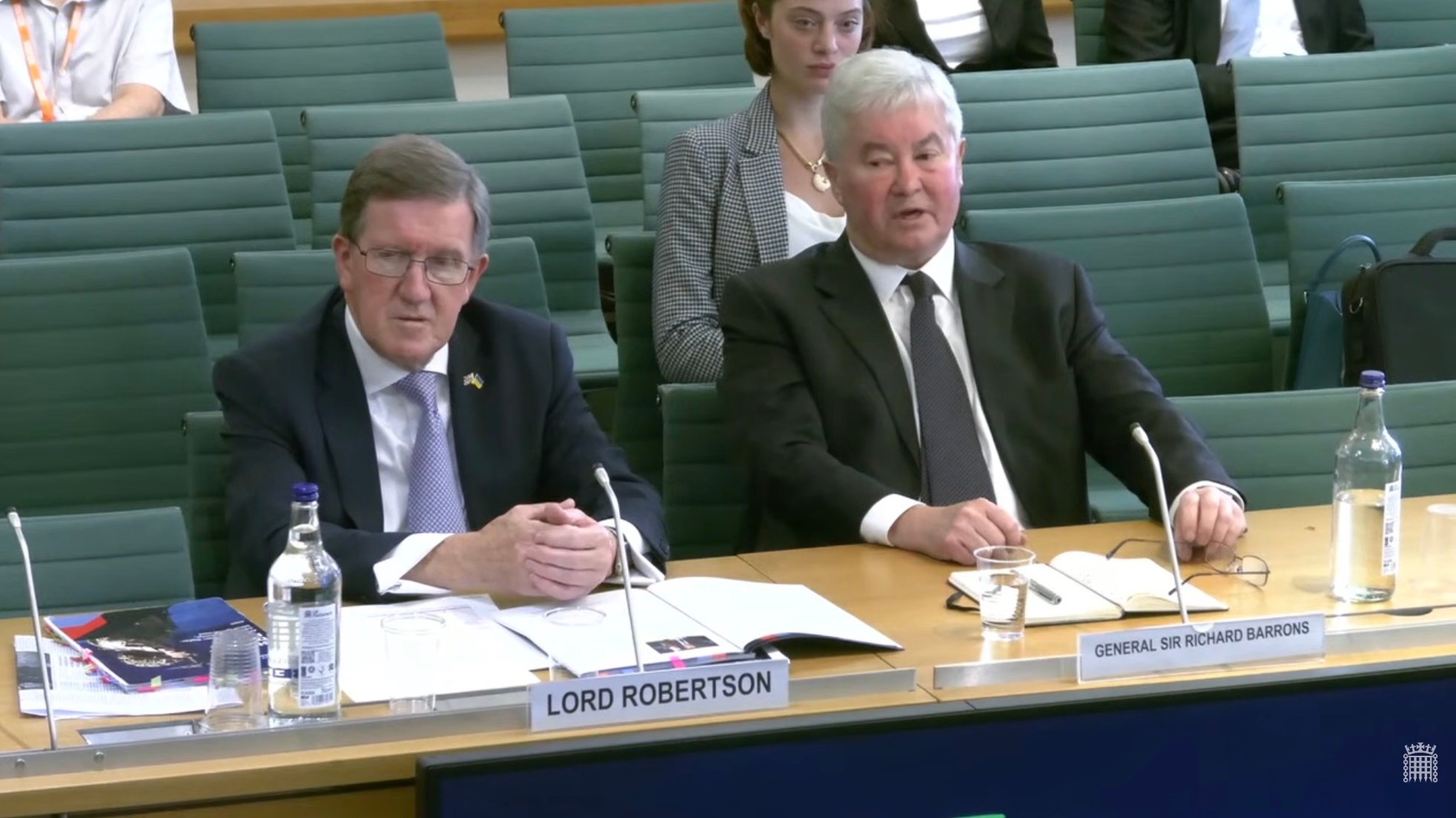
The 2025 Strategic Defence Review identified the threats facing the country and set out a credible direction for reform. The 2026 Defence Investment Plan began translating that strategy into funded programmes. The Defence Committee hearing then exposed the gap between the Government’s plans and the speed at which military readiness may be required.
The NATO Summit in Ankara reinforced the same message internationally: the time for setting targets is giving way to the more difficult task of delivering forces, weapons, infrastructure and industrial capacity.
For UDSS, the conclusion is clear. Britain does not lack strategy. It risks lacking time.
What is the moral responsibility of defence policy?
A government’s responsibility to its Armed Forces extends far beyond authorising military operations or expressing public support for those who serve.
It must ensure that service personnel enter danger with the equipment, training, protection, intelligence, leadership, logistics and national backing necessary to complete their mission and return home.
Where risks are unforeseen, governments must respond as effectively as circumstances allow. But where risks are known and the requirement for preparation is clear, persistent underinvestment becomes a political choice.
That is what makes General Barrons’ warning so significant.
If ministers understand that the Armed Forces may be required to confront a major state threat before the end of the decade, but defer essential capability until later, the consequences cannot be regarded simply as a planning failure.
They become a moral failure because avoidable deaths and injuries may follow from decisions consciously made during peacetime.
Every member of the Armed Forces is somebody’s child, partner, parent, sibling or friend. They accept the inherent risks of service. They should not be expected to accept unnecessary risks created by a failure to prepare.
What did the 2025 Strategic Defence Review say?
Published on 2 June 2025, the Strategic Defence Review described a more dangerous and unpredictable security environment shaped by war in Europe, Russian aggression, nuclear risk, daily cyberattacks and rapid technological change.
It called for the UK to move towards warfighting readiness, adopt a “NATO first” defence policy, develop a more lethal integrated force and build a whole-of-society approach to national resilience. It also emphasised the importance of drones, artificial intelligence, autonomy, data and digital warfare alongside conventional military power. (GOV.UK)
These were important conclusions.
The Review recognised that modern deterrence depends on more than the number of ships, aircraft or armoured vehicles held by the Armed Forces. It depends on whether those platforms can be connected, protected, supplied, repaired and sustained during a prolonged conflict.
It also recognised that national security cannot be delivered by the Ministry of Defence alone. Government, industry, investors, universities, infrastructure providers and wider society must all contribute to national readiness.
The Strategic Defence Review therefore provided a credible strategic destination. The question was how quickly and fully the Government would fund the journey.
What is the UK Defence Investment Plan?
Published on 30 June 2026, the Defence Investment Plan is intended to explain how the Government will deliver the vision established by the Strategic Defence Review.
The Plan is backed by £298 billion of defence investment over four years. It sets out major investment choices intended to move the Armed Forces towards warfighting readiness, strengthen European security and provide greater clarity to Parliament, the public and industry. (GOV.UK)
It includes commitments across nuclear deterrence, maritime capability, autonomous systems, artificial intelligence, drones, cyber, space, munitions and the digital integration of the Armed Forces.
This represents progress. It provides greater direction than a series of disconnected equipment announcements and recognises that defence capability must be considered as an integrated system.
However, the central issue is not whether the Plan contains worthwhile investment. It is whether that investment will produce sufficient military capability at the point when it may be required.
Why did General Sir Richard Barrons warn that the plan may be too late?
General Barrons’ evidence focused on the gap between the Government’s strategic timetable and the potential threat timetable.
The Strategic Defence Review was designed to establish a minimum credible outcome over approximately a decade. Yet political and military assessments have repeatedly warned that Russia could be capable of testing NATO before that transformation is complete.
The Prime Minister has referred to the need to credibly deter Russia by 2030. According to General Barrons, the Defence Investment Plan delivers its minimum outcome around five years after that point.
That creates a fundamental problem.
A military capability that arrives after deterrence has already been tested cannot contribute to preventing the conflict in question.
Deterrence works when a potential adversary believes that aggression will fail or impose unacceptable costs. It depends on capability that exists, forces that are ready and political resolve that is credible now—not simply programmes intended to mature in the following decade.
Lord Robertson and General Barrons appeared before the Defence Committee on 7 July 2026 specifically to consider whether the funding and pace set out in the Defence Investment Plan were sufficient to implement the Strategic Defence Review. (UK Parliament Committees)
General Barrons framed the consequences of inadequate preparation in three parts: strategic failure, operational failure and moral failure.
Strategic failure
Strategic failure occurs when the UK and NATO are unable to deter aggression because an opponent concludes that the Alliance lacks the capability, readiness or political resolve to respond.
Operational failure
Operational failure occurs when the Armed Forces are deployed but cannot achieve their objectives because they lack sufficient force numbers, munitions, protection, infrastructure, medical support, logistics or resilience.
Moral failure
Moral failure occurs when service personnel are sent into conflict despite the Government knowing they were not adequately prepared—and knowing that more may be killed or wounded as a result.
This third failure is the most profound because it turns abstract decisions about budgets and delivery dates into consequences borne by individuals and families.
How does the 2026 NATO Summit affect UK defence policy?
The NATO Summit held in Ankara on 7 and 8 July 2026 moved the Alliance’s focus decisively from setting investment targets to producing measurable results.
NATO Secretary General Mark Rutte said allies were shifting towards delivery: accelerating defence production, reducing barriers, strengthening resilience, investing in innovation and increasing cooperation with industry.
The Summit reported progress towards the Alliance’s commitment to invest 5% of GDP in defence and security by 2035. NATO also announced more than €50 billion in new procurement agreements, a major counter-drone initiative and significant investment in military fuel infrastructure. (NATO)
The Ankara Summit also reinforced the expectation that European allies and Canada must assume greater responsibility for their own security.
This is highly significant for the UK.
Britain continues to play an important role within NATO through its nuclear deterrent, intelligence capabilities, Armed Forces, diplomatic influence and defence industrial base. But Alliance leadership cannot rest on historical reputation or future ambition.
It must be supported by deployable conventional forces, sufficient stockpiles, resilient infrastructure and the capacity to sustain combat operations.
The UK must therefore demonstrate not only that it intends to meet future spending commitments, but that investment decisions are producing credible capability throughout the remainder of this decade.
Why defence spending targets are not enough
Defence spending is an essential input, but it is not in itself a measure of military effectiveness.
A country can increase its defence budget without rapidly improving readiness if money is absorbed by delays, inflation, inefficient procurement, infrastructure backlogs or programmes that will not enter service for many years.
The relevant questions are:
- Can the Armed Forces deploy at the required scale?
- Are sufficient munitions available?
- Can equipment be maintained and replaced?
- Are bases and critical infrastructure protected?
- Is there adequate integrated air and missile defence?
- Can the military medical system manage sustained casualties?
- Can industry increase production during a crisis?
- Can the nation withstand cyberattacks, infrastructure disruption and supply-chain pressure?
These are the practical foundations of deterrence.
The Government must therefore judge success not simply by the amount of money committed, but by the speed at which funding becomes usable military capability.
What does UK defence readiness require before 2030?
The UK must work backwards from the date by which credible deterrence may be required rather than forwards from existing spending settlements.
That means identifying the capabilities that must be operational before 2030 and prioritising them accordingly.
Immediate requirements include stronger integrated air and missile defence, deeper munitions reserves, resilient command-and-control systems, protected infrastructure, effective mobilisation processes, medical capacity and stronger logistics.
The Armed Forces must also be able to integrate conventional weapons with drones, autonomous platforms, artificial intelligence, space-based services and cyber capabilities.
This cannot be delivered by government alone.
Defence companies require clear and sustained demand if they are to invest in facilities, equipment and specialist workforces. Smaller businesses need faster procurement routes and realistic opportunities to scale. Financial institutions require confidence that government priorities will translate into durable programmes.
Universities and technology companies must also be connected more effectively with military users so that innovation can be tested, adapted and deployed in months rather than years.
The UK must prepare industry and wider society
The Strategic Defence Review’s whole-of-society approach should now become an implementation priority.
A major conflict would affect far more than deployed military units. It could disrupt energy, communications, ports, transport, healthcare, financial services, food supplies and digital networks.
National resilience must therefore be treated as part of defence rather than a separate policy area.
Businesses that operate critical infrastructure need a clear understanding of their responsibilities. Government departments must plan collectively. Local authorities and public services need workable resilience arrangements. The public deserves an honest explanation of the risks facing the country and the choices required to address them.
This does not mean creating unnecessary alarm. It means recognising that credible preparation supports deterrence and makes conflict less likely.
An adversary is less likely to act when it sees a country capable of absorbing disruption, mobilising resources and sustaining resistance.
Reform cannot become a reason to delay investment
Defence reform is essential.
The Ministry of Defence must improve procurement, simplify decision-making, reduce duplication and become more comfortable working with commercial technology, private finance and smaller suppliers.
But reform and investment must occur together.
It would be a mistake to argue that additional resources cannot be committed until every structural problem has been resolved. It would be equally mistaken to increase spending without changing the systems that have contributed to delay and cost escalation.
The country needs faster reform and earlier investment.
The security environment will not pause while institutional processes are redesigned.
The real meaning of supporting the Armed Forces
Public support for the Armed Forces is often expressed through ceremonies, commemorations and statements of gratitude. These have value, but they are not enough.
The most meaningful form of support is preparation.
It means giving service personnel the best possible chance of deterring conflict, completing their mission and returning safely to their families.
It means ensuring that they are not asked to compensate for political indecision with personal courage.
It also means recognising that the cost of defence cannot be assessed only in financial terms. Failing to invest may appear cheaper during peacetime, but the eventual price could be paid in national security, lost strategic influence and human lives.
From defence strategy to delivery
The 2025 Strategic Defence Review established the direction for UK Defence. The 2026 Defence Investment Plan began to allocate resources. The Defence Committee hearing highlighted the risk that delivery will arrive after the point at which deterrence may be tested.
The NATO Summit demonstrated that allies are now concentrating on production, capability, resilience and execution.
The next phase must therefore focus relentlessly on delivery.
UDSS believes that government, defence, industry and finance must work together to turn strategic ambition into operational capability before the end of this decade.
The choices required may be politically and economically difficult. But failing to make them would carry a far greater cost.
As General Barrons made clear, the issue is not only whether Britain’s strategy succeeds or whether military operations can be sustained. It is whether the nation has fulfilled its moral responsibility to the people it may ask to fight.
Those serving today are all somebody’s children.
They must never be sent into conflict knowing that their country understood the danger, had time to prepare—and chose not to do enough.
Frequently asked questions
What is the UK Strategic Defence Review 2025?
The Strategic Defence Review 2025 is the Government’s framework for transforming UK Defence in response to increasing Russian aggression, conflict in Europe, cyber threats and rapid technological change. It calls for warfighting readiness, a “NATO first” policy, greater military lethality, innovation and a whole-of-society approach to resilience.
What is the Defence Investment Plan 2026?
The Defence Investment Plan, published on 30 June 2026, sets out major investment choices intended to deliver the Strategic Defence Review. It is backed by £298 billion over four years and covers areas including the nuclear deterrent, ships, drones, AI, cyber, space and munitions.
Why does General Sir Richard Barrons believe the plan may be too slow?
General Barrons argues that the Plan’s minimum intended outcome may not be delivered until around 2035, despite the need for the UK to contribute credibly to deterring Russia by approximately 2030. This creates a gap between when capability may be needed and when it is expected to arrive.
What is moral failure in defence policy?
Moral failure occurs when a government sends military personnel into danger while knowing that it chose not to provide the preparation, equipment, protection and support reasonably required. The result may be avoidable deaths and injuries.
What happened at the NATO Summit in Ankara?
At the July 2026 NATO Summit, allies focused on turning defence spending commitments into military results. NATO highlighted increased investment, expanded industrial production, major procurement agreements, stronger resilience and greater European responsibility for collective defence.
What must the UK do to improve defence readiness?
The UK must accelerate investment in munitions, integrated air and missile defence, logistics, medical capacity, infrastructure, technology and industrial production. It must also reform procurement and strengthen collaboration between government, the Armed Forces, industry, finance, academia and wider society.