
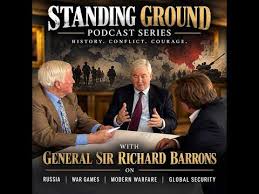
Russia’s confrontation with Europe, the lessons of Ukraine and the urgency of strengthening UK defence are central to General Sir Richard Barrons’s conversation on the STANDING GROUND podcast. For governments and businesses alike, the interview raises questions about preparedness in an increasingly contested security environment.
Britain’s security depends on recognising how conflict is changing—and acting quickly enough to deter it.
That is the central message from General Sir Richard Barrons, Co-Chair of Universal Defence and Security Solutions (UDSS), in his interview with Colonel Bob Stewart DSO and Quentin Drummond Anderson on STANDING GROUND.
The discussion examines Russia’s intentions, the war in Ukraine, NATO’s collective strength and the gap between identifying threats and delivering the capabilities needed to address them. Sir Richard’s argument is clear: the UK and its European allies have the resources to strengthen their security, but the pace of preparation matters.
Russia’s confrontation with Europe extends beyond Ukraine
Sir Richard argues that Russia already considers itself in confrontation with Europe and the UK. Understanding that perspective is essential to recognising activity that takes place below the threshold of open military conflict.
In the interview, he describes cyber disruption, threats to critical infrastructure, physical sabotage and attempts to influence political debate. Such activities can undermine everyday life and public confidence without resembling a conventional military attack.
His warning concerns the potential for escalation. Disruption that is limited today could become substantially more damaging if a hostile state chose to intensify its efforts.
For the UK, this means security planning must address both military threats and the vulnerability of the systems that sustain the economy and essential services.
Ukraine demonstrates why deterrence matters
The war in Ukraine runs throughout the conversation as a reference point for understanding contemporary conflict.
Sir Richard discusses Russia’s failure to achieve its strategic ambitions, alongside the military experience and industrial mobilisation generated by a prolonged war. His analysis challenges the assumption that Russia’s difficulties in Ukraine necessarily remove its capacity to threaten other European countries.
He also highlights the combination of missiles, drones and cyber disruption that could characterise a wider confrontation. Geographic distance offers limited reassurance against capabilities that can reach beyond a land border.
The purpose of examining these possibilities is to strengthen deterrence. Credible preparedness can influence an adversary’s calculations and reduce the likelihood that it sees an opportunity worth exploiting.
Could Russia test NATO’s resolve?
A central concern in the interview is whether Russia might attempt a limited action designed to expose divisions within NATO.
Sir Richard explores scenarios in which Moscow could seek to test the willingness and ability of allies to respond collectively. These are possible contingencies, rather than predictions of a particular attack. Their significance lies in the political objective: weakening confidence in the alliance by demonstrating that its members cannot act together.
His argument is that Europe’s collective economic and industrial strength gives it a substantial advantage. Converting that strength into effective deterrence, however, requires capability, readiness and political cohesion.
An adversary’s perception of a temporary opportunity could matter as much as the longer-term balance of power.
A stronger European contribution to collective security
Sir Richard makes the case for a stronger European pillar within NATO, while emphasising the value of the transatlantic alliance.
European nations, he argues, need to take greater responsibility for their security and reduce vulnerabilities arising from excessive dependence on others. The challenge involves more than increasing spending.
Investment must reflect the changing character of warfare. The interview questions whether some European rearmament efforts place too much emphasis on recreating older force structures, rather than adapting sufficiently to the lessons of contemporary conflict.
For the UK, this means developing capabilities that complement those of allies while addressing its own exposure. Other countries’ investments cannot substitute for protecting British infrastructure, maintaining national readiness or defending against threats approaching from different directions.
Britain’s challenge is the speed of delivery
Sir Richard repeatedly returns to the gap between the urgency of the threat assessment and the time required to implement defence plans.
As one of the authors of the Strategic Defence Review, he argues that identifying the right direction is only part of the task. Delivering transformation at a pace that contributes to deterrence is equally important.
Asked to identify his priorities, he highlights three areas:
- Restoring national resilience, including infrastructure, mobilisation arrangements and wider societal preparedness.
- Strengthening integrated air and missile defence against the types of threats demonstrated in contemporary conflicts.
- Accelerating military transformation, supported by faster investment and effective public–private arrangements.
These priorities connect military capability with industrial capacity, infrastructure and the ability of society to endure disruption.
What this means for business and industry
The interview’s implications extend into the boardroom.
Businesses depend on the infrastructure and international stability discussed throughout the conversation. They also contribute expertise, technology, finance and industrial capacity that can support stronger defence and national security.
For leaders, the practical challenge is to understand how geopolitical developments affect their organisation—and translate that understanding into decisions about operations, investment, partnerships and preparedness.
This includes assessing exposure to disruption, examining dependencies and considering where a business’s capabilities can contribute to defence requirements.
How UDSS can support your organisation
UDSS brings together senior defence and security expertise to help organisations interpret a changing strategic environment and respond with greater clarity.
Whether your business needs to understand geopolitical risk, review its preparedness or explore opportunities within the defence sector, informed advice can help connect strategic developments with practical decisions.
Contact UDSS to discuss how our experts can support your business with strategic insight, security risk assessment and planning for a more demanding operating environment.
Listen to the interview
Listen to Sir Richard Barrons on STANDING GROUND on Spotify, or explore the STANDING GROUND YouTube channel.
Hosted by Colonel Bob Stewart DSO and Quentin Drummond Anderson, STANDING GROUND explores history, conflict and national security through conversations with people who have experienced and helped shape events.