
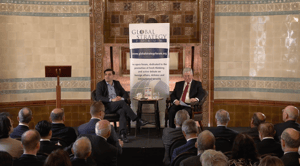
General Sir Richard Barrons KCB CBE, Co-Chair of Universal Defence and Security Solutions, chaired a Global Strategy Forum discussion with author, broadcaster and security journalist Gordon Corera on the enduring lessons of Soviet intelligence, Russian statecraft and the continuing relevance of the Mitrokhin Archive.
The invitation-only event, held on Wednesday 20 May 2026, explored themes from Corera’s book, The Spy In The Archive: How One Man Tried To Kill The KGB, which tells the remarkable story of Vasili Mitrokhin, the KGB archivist who secretly copied and smuggled one of the most significant intelligence archives of the Cold War to the West.
For UDSS, the discussion speaks directly to one of the central strategic questions facing the UK and its allies today: how far do the methods, mindset and culture of Soviet intelligence continue to shape the behaviour of the Russian state under President Vladimir Putin?
Intelligence, power and the long shadow of the KGB
Mitrokhin’s story is not simply a historical account of Cold War espionage. It is a case study in how authoritarian systems use secrecy, coercion, disinformation and covert influence to protect power at home and project it abroad.
That question remains highly relevant today. Russia’s war against Ukraine, its use of cyber operations, information warfare, sabotage, political interference and energy pressure all demonstrate that modern conflict is not confined to the battlefield. It is fought across societies, economies, institutions and public trust.
As Co-Chair of UDSS, General Sir Richard Barrons brings a strategic defence perspective to these issues. A former Commander Joint Forces Command and an External Reviewer of the UK Strategic Defence Review 2025, he has consistently argued that the UK and its allies must understand security in broader terms: not only as a matter of military capability, but as a test of national resilience, political will, industrial capacity and strategic clarity.
The Mitrokhin Archive provides an important historical lens through which to examine those challenges. It reminds us that intelligence activity is not peripheral to state power. For Russia, it has often been central to how influence is exercised, adversaries are weakened and narratives are shaped.
Why history matters to today’s strategic environment
The current geopolitical environment makes this discussion particularly timely. The war in Ukraine continues to test European security, NATO cohesion and Western defence capacity. At the same time, Russia’s wider use of hybrid activity has reinforced the need for governments, industry and civil society to recognise threats earlier and respond with greater coordination.
The lesson from Mitrokhin is that archives matter because memory matters. What was revealed about the KGB’s methods helps today’s decision-makers understand the continuity between past and present: the use of covert networks, strategic deception, ideological manipulation and the exploitation of open societies.
This does not mean that today’s Russia is identical to the Soviet Union. But it does mean that many of the instincts and practices associated with KGB-era statecraft remain relevant when assessing the Kremlin’s approach to power, security and confrontation with the West.
Strategic insight for a contested age
UDSS works with governments, institutions and organisations facing complex strategic risk. Events such as this Global Strategy Forum discussion are important because they connect historical understanding with present-day decision-making.
For defence and security leaders, the issue is not simply what happened in the Cold War. It is what those events reveal about the behaviour of hostile states today, and what the UK and its allies must do to protect democratic resilience, critical infrastructure, information integrity and national security.
General Sir Richard Barrons’ role in chairing the discussion reflects UDSS’ wider commitment to serious strategic debate at a time when the UK faces a more volatile and contested international environment. Understanding adversaries requires more than reacting to the latest crisis. It requires historical depth, intelligence awareness and the ability to see patterns before they become strategic shocks.
The story of Vasili Mitrokhin is therefore more than an extraordinary intelligence operation. It is a reminder that truth, courage and institutional memory remain vital assets in the defence of open societies.