
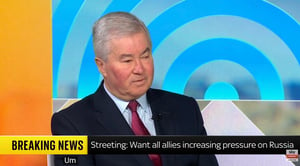
Defence readiness cannot wait: Sir Richard Barrons on the urgency of deterrence
The UK and its NATO allies must move faster to strengthen their defences, warns UDSS Co-Chair General Sir Richard Barrons. The challenge is to deliver the capability needed to deter aggression within the timeframe the threat demands.
Speaking on Sky News’ Sunday Morning With Ruth Davidson, Sir Richard argued that the pace of defence investment and reform must reflect a security environment that is becoming more dangerous.
As one of the authors of the 2025 Strategic Defence Review, he welcomed the Government’s commitment to implementation. But he questioned whether a programme delivered over ten years could meet threats that may emerge considerably sooner.
“The question is not just what have you got to do,” he said. “It’s how quickly must you do it to deter?”
Closing the readiness gap
Sir Richard described two substantial tasks facing UK defence.
The first is transforming the armed forces for war as it is fought today, drawing on lessons from Ukraine and other conflicts to adapt how forces operate, use technology and sustain themselves.
The second is rebuilding the foundations of military readiness: ammunition, spares, training and personnel. He argued that decades of reductions had left shortages that now need to be addressed alongside that transformation.
Together, these demands create a considerable gap between current capability and what the changing security environment requires. A long-term investment programme can help close it, but its value depends on when usable capability becomes available.
Sir Richard also highlighted integrated air and missile defence as an example of a requirement whose full scale, in his assessment, extends beyond the provision in existing plans. Protecting parts of the UK against modern aerial threats would require substantial investment and difficult decisions about priorities.
Finding that funding sooner brings political choices. Delaying it, he warned, carries strategic consequences.
Making aggression an unacceptable choice
Sir Richard was careful to distinguish a possible Russian attack on NATO from an inevitable or likely one.
His concern was that Russia could perceive a window of opportunity if European defence preparations remain slow and confidence in US support weakens. He described a scenario involving a limited military action intended to test NATO’s collective defence commitment, accompanied by cyber operations, disinformation and sabotage.
The objective, he argued, must be to remove any expectation that such an action could succeed.
“Let’s make it inconceivable that Mr Putin thinks that’s a good idea.”
That requires credible military capability, political resolve and the ability to respond together. It also requires recognising that hostile activity can affect national security well before a conventional military confrontation begins.
Ukraine remains central to European security
Sir Richard placed the outcome of the war in Ukraine at the centre of the UK’s long-term security interests.
He argued that allowing Russia to benefit from aggression would increase the risks facing Europe. Supporting Ukraine therefore remains integral to the wider task of deterrence.
Asked about the consequences of purchasing Russian energy, he emphasised the connection between those revenues and Russia’s ability to sustain its military campaign. His broader warning was that decisions driven by immediate economic or electoral pressures can undermine longer-term security.
For governments and their partners, the challenge is to maintain strategic purpose while managing those competing demands.
The implications extend to business
The interview also underlined how closely national security is connected to commercial resilience.
Discussing the risk of further disruption in the Middle East, Sir Richard highlighted the importance of maritime access to the Suez Canal and the UK’s dependence on goods moving through it. Disruption to a distant shipping route can create consequences for organisations far beyond the immediate conflict.
For business leaders, these issues raise practical questions. Which critical operations depend on vulnerable transport routes or suppliers? How would the organisation respond if a cyber incident coincided with physical disruption? Can leaders make timely decisions with incomplete information?
These questions deserve attention before a crisis exposes the answers. Understanding dependencies, testing assumptions and preparing people to act are essential parts of organisational readiness.
UDSS supports governments, defence organisations and businesses with expertise in defence modernisation, security, risk analysis, supply chain resilience and leadership development. We help organisations understand what a changing threat environment means for their priorities and preparedness.
To discuss your organisation’s security and resilience requirements, contact UDSS.